
Canada Without Poverty (CWP), as it is known today, has a long history of representing the interests of low-income and impoverished Canadians. The organization was founded officially in 1971 as the National Anti-Poverty Organization (NAPO) as a result of the first national Poor People’s Conference.
The first decade of CWP/NAPO’s work is indicative of the variety of initiatives that the organization is involved with at any given time. NAPO presented a brief on the connection between food, nutrition and low income to the House of Commons Special Committee on Trends in Food Prices in 1973. It argued for, and won the retention of, the 10-cent payphone and successfully argued against a proposed increase in rates by Bell Telephone. NAPO then published Out of Work, which was considered to be the most up-to-date reference on the federal Unemployment Insurance Program at the close of the 1970s.
In the 1980s, NAPO continued to present to Parliament on a number of issues that relate to poverty; namely healthcare, housing, unemployment insurance, job training, the taxation system, family benefits, pensions, financial services and phone rates. In 1989, NAPO also embarked on a large research project on the strengths and weaknesses of job training programs from the perspective of participants on social assistance. The final report was entitled You Call it a Molehill, I’ll Call it a Mountain: Job Training for People on Social Assistance after the story of an exchange between a welfare agent and a recipient who disagreed about the significance of a $25 difference in payments.
NAPO’s attention shifted to the international realm beginning in the 1990s; in 1993, it was the first non-profit organization, along with the Charter Committee on Poverty Issues, to be invited to speak to the United Nations Committee on Economic, Social, and Cultural Issues about Canada’s human rights performance. NAPO returned to speak to the Committee again in 1995 and 1998 regarding the reforms to the Canada Assistance Plan. NAPO was a member of the Canadian NGO Organizing Committee that brought Canadian delegates to the World Summit for Social Development in 1995 in Copenhagen. The following year, NAPO participated in Habitat 2 (an initiative by the United Nations to bring attention to housing issues) in Turkey. In 1998, NAPO co-hosted a Poverty Roundtable in Santiago, Chile on the topic of economic and social rights.
This focus on economic and social rights also seen domestically, as NAPO worked to improve the attainability and enjoyment of these rights for impoverished Canadians. In 1993, NAPO organized the Nation-Wide Poor People’s Conference (the first since the 1971 session that created NAPO) in Ottawa with 120 delegates. The conference brought together representatives of anti-poverty groups and produced some striking insights into the plight of those who lived in poverty and their access to social assistance programs. The following year, in response to major reforms to the Canada Assistance Plan (CAP) proposed by the federal government, NAPO spoke out on behalf of low-income Canadians. When the CAP was dismantled, NAPO fought to reinstate standards for welfare at the national level. At the provincial level, NAPO made submissions to the Ontario legislature with regards to tenants’ rights.
At the municipal level, NAPO claimed a legal victory in 2000 when the City of Winnipeg conditionally repealed the city by-law against pan-handling; NAPO had claimed that the by-law was unconstitutional and that it discriminated against the poor by distinguishing them from other citizens. It was around this time that NAPO began speaking out against “poor-bashing” or the practice of blaming socio-economic problems in society on those living in poverty. NAPO/CWP has continued to criticize the practice of “poor-bashing” in Canada to the present day.
In the same year (2000), NAPO received honourable mention from the Canadian Council for International Co-operation for its work on poverty eradication and human development internationally. It also made further submissions to Parliament about access to basic banking services.
In the years following, NAPO published a major report called Voices: Women, Poverty, and Homelessness in Canada to educate the Canadian public about homelessness from the perspective of those experiencing it. NAPO also launched a campaign to raise minimum wage standards at all levels of government to help individuals escape or avoid living in poverty.
In 2008, NAPO adopted new mission, vision and values statements to reflect the belief that poverty is a violation of human rights and that poverty elimination is a human rights obligation. In 2009, NAPO became Canada Without Poverty (CWP) in order to better reflect the ultimate goal of the organization. A new organizational logo was adopted which symbolizes rising above the poverty line towards a brighter future.
Also in 2009, CWP partnered with Citizens for Public Justice to launch Dignity for All: The Campaign for a Poverty-free Canada which aims to make Canada poverty-free, socially secure and cohesive by the year 2020.
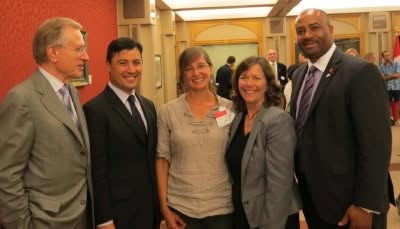
2012 was an important year for CWP with the launch of the new human rights education program, carried out through online courses and in-person workshops. It was also the year that Leilani Farha, renowned human rights and housing expert, joined CWP as the new Executive Director. Two years later in June 2014, Leilani Farha was appointed as the UN Special Rapporteur on Adequate Housing in addition to her role as Director of CWP.
The DfA Campaign significant progressed in early 2015 when its model national anti-poverty plan was released (click here for the plan in English or en français). Also in 2015, CWP continued NAPO’s tradition of presenting to the United Nations on Canada’s human rights performance with submissions to the Committee on Economic, Social and Cultural Rights and the Human Rights Council. Canada Without Poverty has been an active participant in many of the meetings of the All-Party Anti-Poverty Caucus since its inception in June 2012.